- Published on
How Polkadot enables multi chain applications
Language: English
Author: Dustin
Level: Beginner
Polkadot enables multi-chain dApps by providing a shared-security network where specialized blockchains run in parallel and communicate natively. With the introduction of Polkadot Hub (formerly Asset Hub), developers can now deploy smart contracts directly on a system chain that benefits from Polkadot's shared security and native cross-chain messaging (XCM).
Instead of relying on third-party parachains for smart contract execution, Polkadot Hub offers a first-class, native environment powered by PolkaVM—a next-generation virtual machine built on RISC-V architecture.
1. The Core Model: Relay Chain, System Chains & Parachains
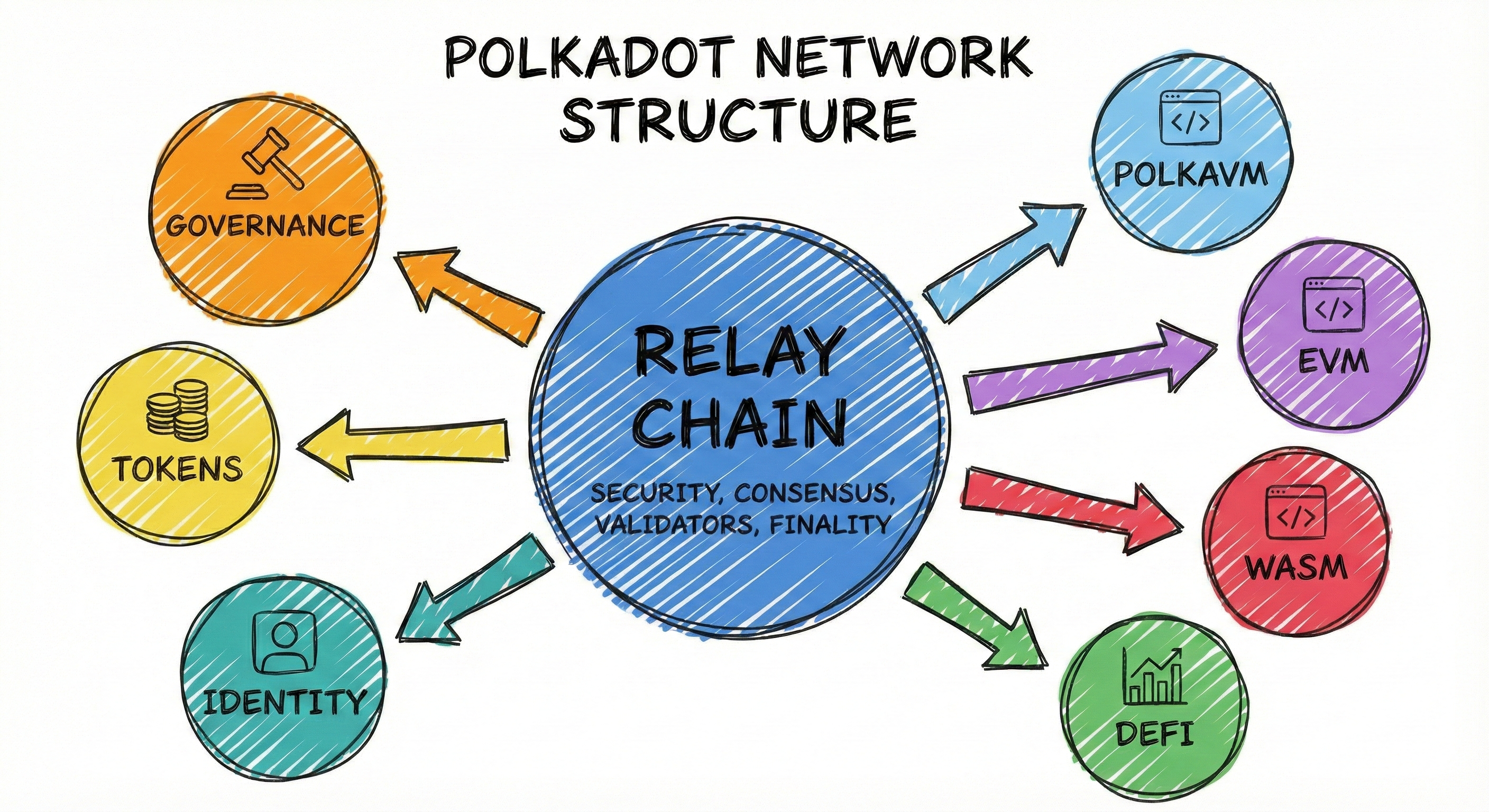
Polkadot operates on a hub-and-spoke model with three key components:
| Component | Role | Responsibility |
|---|---|---|
| Relay Chain | Central Security Hub | Consensus, Validator Management, Shared Security |
| System Chains | Core Infrastructure | Assets, Bridges, Identity, Smart Contracts (Polkadot Hub) |
| Parachains | Application-Specific Chains | Custom Logic, Governance, Specialized Execution |
System Chains: The Backbone
System chains are privileged parachains maintained by Polkadot governance. They provide essential infrastructure:
- Polkadot Hub (Asset Hub): Native asset management and smart contract execution via PolkaVM
- Bridge Hub: Trustless bridges to external networks (Ethereum, Kusama)
- Coretime Chain: Manages blockspace allocation for parachains
- People Chain: Decentralized identity services
Why this matters: Polkadot Hub allows developers to deploy smart contracts with native access to XCM, shared security, and low fees—without needing to launch or depend on a separate parachain.
2. PolkaVM: Native Smart Contracts on Polkadot Hub
PolkaVM is Polkadot's native virtual machine, designed from the ground up for the multi-chain ecosystem. Unlike EVM-based solutions on parachains, PolkaVM runs directly on Polkadot Hub as a first-class citizen.
Key Features
| Feature | Description |
|---|---|
| RISC-V Architecture | Modern, efficient instruction set with excellent tooling support |
| Solidity Support | Write contracts in Solidity, compiled to RISC-V via resolc compiler |
| ink! Support | Native Rust-based smart contracts using the ink! framework |
| Native XCM | Built-in cross-chain messaging without bridges or adapters |
| Lower Fees | Optimized execution costs compared to legacy L1 platforms |
Development Options
Developers can choose their preferred approach:
Option A: Solidity on PolkaVM
- Use familiar Ethereum tooling (Hardhat, Foundry, Remix)
- Compile Solidity to RISC-V using the
resolccompiler - Deploy to Polkadot Hub with Ethereum-compatible RPC
Option B: ink! (Rust)
- Write contracts in Rust using the ink! eDSL
- Compile to PolkaVM bytecode
- Leverage Rust's type safety and performance
// Example: Simple storage contract on PolkaVM
// SPDX-License-Identifier: MIT
pragma solidity ^0.8.0;

contract SimpleStorage {
    uint256 private value;

    event ValueChanged(uint256 newValue);

    function setValue(uint256 _value) public {
        value = _value;
        emit ValueChanged(_value);
    }

    function getValue() public view returns (uint256) {
        return value;
    }
}
Note: PolkaVM is currently in preview release. Check the official documentation for the latest updates.
3. XCM: Cross-Chain Messaging from Polkadot Hub
Cross-Consensus Messaging (XCM) is the universal language that allows dApps on Polkadot Hub to interact with the entire ecosystem. Smart contracts deployed on Polkadot Hub have native access to XCM capabilities.
What XCM Enables
- Asset Transfers: Move tokens between Polkadot Hub and any parachain
- Remote Execution: Trigger actions on other chains from your smart contract
- Cross-Chain Queries: Read state from connected parachains
- Unified UX: Users interact with one interface while actions happen across multiple chains
XCM Precompile on Polkadot Hub
Smart contracts on Polkadot Hub can access XCM functionality through precompiled contracts:
// Example: Transfer DOT to another parachain using XCM precompile
interface IXCM {
    function transferAssets(
        uint32 destParaId,
        bytes calldata beneficiary,
        uint256 amount
    ) external;
}

contract CrossChainTransfer {
    IXCM constant xcm = IXCM(0x0000000000000000000000000000000000000803);

    function sendToParachain(
        uint32 paraId,
        bytes calldata recipient,
        uint256 amount
    ) external {
        xcm.transferAssets(paraId, recipient, amount);
    }
}
Multi-Chain Application Architecture
With Polkadot Hub as your smart contract layer, you can build applications that span multiple chains:
4. Bridging to External Ecosystems
Multi-chain dApps on Polkadot Hub can extend beyond the Polkadot ecosystem through trustless bridges:
Native Bridges (via Bridge Hub)
- Snowbridge: Trustless bridge to Ethereum, enabling ETH and ERC-20 transfers
- Hyperbridge: Cross-chain messaging protocol for broader interoperability
How It Works
- Deploy your smart contract on Polkadot Hub
- Use XCM to send messages to Bridge Hub
- Bridge Hub relays messages to external networks
- External assets flow back through the same path
Result: Your Polkadot Hub smart contract can interact with Ethereum liquidity and users while maintaining Polkadot's security guarantees.
Conclusion: Why Build on Polkadot Hub?
Polkadot Hub represents a paradigm shift for multi-chain application development:
| Benefit | Description |
|---|---|
| Native Smart Contracts | Deploy directly on a system chain without launching your own parachain |
| Shared Security | Inherit Polkadot's validator set and consensus from day one |
| Native XCM | First-class cross-chain messaging without adapters or bridges |
| Developer Familiarity | Use Solidity, Hardhat, and existing Ethereum tooling |
| Lower Barrier | No need to acquire coretime or manage parachain infrastructure |
The combination of PolkaVM's modern architecture, native XCM integration, and Polkadot's shared security makes Polkadot Hub the ideal foundation for building the next generation of multi-chain applications.
Resources: